Investment Help

If you are seeking investment help, look at the video here on my services. If you are seeking a different approach to managing your assets, you have landed at the right spot. I am a fee-only advisor registered in the State of Maryland, charge less than half the going rate for investment management, and seek to teach individuals how to manage their own assets using low-cost indexed exchange traded funds. Please call or email me if interested in further details. My website is at http://www.rwinvestmentstrategies.com. If you are new to investing, take a look at the "DIY Investor Newbie" posts here by typing "newbie" in the search box above to the left. These take you through the basics of what you need to know in getting started on doing your own investing.

Tuesday, November 6, 2012

Do You Care Where Your Money Is Invested?

If you care about social issues and such as it relates to investing, there are two basic schools of thought.  One is to do the best you can investing and then donate to the causes that are meaningful to you, and the other is to invest in socially responsible companies.  The first approach is obviously easier but may cause you to toss and turn as you see visions of companies producing cigarettes, military hardware, and engage in practices you view as destroying the planet and even unethical.

The second approach is a bit more challenging.  The easy way out is to use a socially responsible fund. By googling "social responsible funds," you can get a wealth of information on funds meeting various criteria.  They have periods where they outperform the market but, in general, have underperformed a bit.  One reason is that they tend to be high-priced in terms of expense ratios - understandable in that they require quite a bit of research and fairly intensive screening.

There are other ways to approach the problem, for those willing to do their own research, and they are laid out neatly in the book Low Fee Socially Responsible Investing by Tom Nowak.  The book recommends different approaches for various size accounts as well a screening approach.  Useful, also, are a databases for screening criteria.  The book can read in a weekend.

Here is a podcast of an interview of the author Tom Nowak by Jim Ludwick of MainStreet Financial Planning, Inc.

Monday, November 5, 2012

A Simple Asset Allocation Spreadsheet

At the bottom of this investment article from Rutgers University, directed to farmers, is a simple Excel spreadsheet one of my clients found for tracking asset allocation.  The spreadsheet is useful for bringing accounts together and determining when re-balancing needs to take place.  As has been discussed here frequently, asset allocation is the most important determinant of overall investment return.

The approach I, and many others, recommend is to identify an appropriate asset allocation and stick to it through market ups and downs.  In this way, the key emotional factors that investors struggle with are defeated.

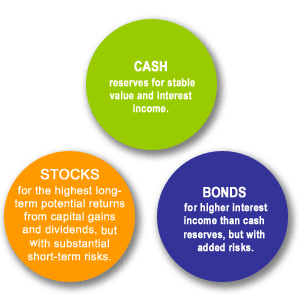
Cash investments include money market accounts, certificates of deposit, savings accounts, etc.  Fixed income investments include bonds, bond mutual funds, and bond ETFs, etc.

Once you get the hang of it, you should break out equities into domestic and foreign.  Somewhere down the line, you may want to also break out large cap and small cap stocks.

Saturday, November 3, 2012

A Bucket Approach to Portfolio Allocation for Retirees

One of my important functions is to advise retirees on allocating assets--a perspective that shifts at retirement from nest egg accumulation to decumulation.  The retiree goes from hoping that markets fall so that he or she can buy assets cheaply to praying for rising markets to push their nest egg higher, from which they will generate a paycheck for the next 25 years or so.

The need to generate the paycheck and the increased sensitivity to declining markets raises the potential for emotional factors to derail the whole process for the retiree.  This was seen in 2008.  With a drop in stocks of 37%, it was easy to understand the fears of those living off their nest egg.

One approach to this problem is the so-called "bucket approach" to asset allocation.  This approach provides a structure for riding out market downturns.  Although it seems unique, it actually is not so different from a standard approach--as I'll explain later.  The bucket approach is very nicely described by Christine Benz, Morningstar's Director of Research in A Bucketed ETF Portfolio for Moderate Retirees.

This article lays out a specific allocation in terms of 3 buckets with recommended ETFs for each bucket.  This creates a nice visual effect for the retiree to understand the purpose of each part of the portfolio.  The first bucket is intended to meet expenditures over the first few years and is comprised of low-risk cash equivalent types of ETFs.  The second bucket is primarily fixed income and is positioned to meet the middle years, and the 3rd bucket is riskier stocks, high-yield bonds and commodity ETFs intended to produce growth.

The advantages of the bucket approach is that, as mentioned above, it should enable the retiree to weather market downturns and visually see how the portfolio replenishes its needs.  Furthermore, it is efficient and doesn't require retirees to spend their retirement managing their portfolios.  Ms. Benz argues that her recommended portfolio should enable a retiree to withdraw 5% of assets, inflation adjusted, over a 20-year time frame.

I believe that her article is useful reading for anyone in retirement or nearing retirement.

As mentioned above, though, the bucket approach is not much different from the standard asset allocation approach.  For example, for some of the retirees I manage assets for and advise, I use the 40% stocks/60% fixed and cash allocation model.  Ten percent of this allocation is cash; so, right off the bat, the usual approach will have the 2 years' cash needs met as in the bucket approach.  Also, the 10% allocation will be replenished on an ongoing basis via portfolio re-balancing.  The 40% stocks is, as above, intended for growth; but, if stocks do very well, they could be used to replenish the other parts of the portfolio and, in fact, could be used to meet cash needs.

One stipulation I put in for retirees drawing down their nest egg is that the yield on the overall portfolio be at least 60% of  cash needs.  Thus, if the retiree is drawing down 4%, the portfolio needs to yield at least 2.4%.  This may mean some jockeying into dividend ETFs, etc.  Thinking about this a bit, you'll realize that more than 2 years' protection is built in !

Furthermore, if the market is down, all cash flows go to cash.  We live in a world where markets have always recovered (at least in the U.S.) and, thus, people believe they always will.  Those in retirement need to be careful, I believe, in making this assumption.


Thursday, November 1, 2012

Stress - Can You Handle It?

Barron's reports this week that investment managers have turned bearish and performance numbers show that they are behind their benchmarks year-to-date.  All of this as we see the market starting November with a strong performance.  What do they do now - hold their nose and jump in at the risk of getting whipsawed?  Or do they stay on the sidelines and potentially miss a good move?  Stress is undoubtedly high.

There are a lot of uncertainties - corporate earnings, the election, Europe, the fiscal cliff.  Still, the market holds in.

And this isn't an unusual situation.  It is the nature of the market that many times you can make a list of negatives longer than your arm and yet the market moves sharply higher.  The opposite case is obviously true as well.

One of the benefits of the investment approach I, and many others, choose is that it limits this market  stress.  Instead of the stock picking/market timing stress-inducing approach promoted by the Wall Street community, we prefer to focus on asset allocation and then satisfy this allocation using low-cost, market-tracking exchange traded funds.  We get that the market is going to be up big and down big.  We believe, however, that over the long run the economy and the market will produce good performance as innovation and global growth take successful companies higher.

I realize that some of you may not have bought into this approach just yet and are on the sidelines pulling your hair out.  To you, I offer a piece First Understand, Then Destroy Stress by one of my favorite bloggers - none other than Mr. Money Mustache .

Wednesday, October 24, 2012

An Intro to Long Term Care Insurance

Like Pac Man gobbles up dots, long-term care can gobble up a nest egg.  It is an unpleasant subject but one that is important--not just for those heading up households but also for those anticipating the role of caregiver.  Planning for long-term care is important  from the financial aspect and also because of the stress it can impose on a family.

Here, from Jim Blankenship at Getting Your Financial Ducks in a Row, is an excellent intro entitled "Long Term Care Insurance - Protecting Your Nest Egg."

Tuesday, October 23, 2012

High Fees and Low Cost ETFs

If you are a serious investor and don't know who Jason Zweig is, you should.  His book, Your Money and Your Brain, is a must read.  Very well written, it will make every investor better.

Recently he has examined a use of ETFs, When Cheap Funds Cost Too Much,  that overrides one of their  biggest benefits:  low expenses.  As Zweig points out, some advisors use ETF strategists--thereby adding a 3rd layer of fees to the investment process.  There is the advisors's fee, the strategist's fee, and the expenses of the ETF itself.  He points out this can drive costs to between 1% and 3% of portfolio assets.  Included may be a transactions cost incurred when ETF funds are traded.

A broader issue Zweig discusses is that strategists frequently provide performance results that are not real client performance results - they are back-tested results.

All of this can be avoided, and is, by numerous advisors.  I, like some other advisors, for example, index the market, avoid the "middle man" strategist, and use mostly commission-free ETFs.  Performance, in line with the objective,  is going to be close to the benchmark.  For example, here is performance for a typical client (note that it is up-to-date and can be seen by the client anytime she wishes by going online!):

Source:Schwab
CLICK TO ENLARGE
As you can see, performance since inception of the account is within .20% (average cost of ETFs) of the benchmark.  Note that the benchmark is explicitly listed in the footnote.  Each client has a specific benchmark reflective of their risk tolerance.

My fee is .4% to set up the account, manage it on an ongoing basis, and rebalance as necessary - all mystery eliminated voila'. Total cost, all in, is .6%.  If she did it herself, it would be .2%.  As a matter of emphasis, the layers pointed out by Zweig results in the usual opaqueness in fees and costs that Wall Street is adept at creating.


Tuesday, October 16, 2012

An Interview With an Investment Genius

Source: Valuewalk.com
Bruce Berkowitz of Fairholme Capital is a genius.  Watch this video of an interview by Consuelo Mack on the Wealthtrack program and see if you don't agree.  Consuelo Mack is an excellent interviewer and has a knack for asking the questions, including the tough questions, that do-it-yourself investors have.

Although Berkowitz hit a rough spot over the recent past, he appears to be on the rebound in 2012 and, over the long term, has produced one of the best track records in the industry, thereby earning the prestigious title of "Manager of the Decade" from Morningstar.

As you'll see in the video, Berkowitz knows the inside and outside of the companies he invests in and sticks with his convictions over the long term.  He, like Warren Buffet and a select few others, is the epitome of a value investor.

I caught the end of the interview as I was channel flipping but then came across it on The Biz of Life site - thanks "Grouch."

In the approach to investing I use, I would limit exposure to 10% of an active fund like this.  The probability that Berkowitz will beat the market by a goodly margin over the next 10 years or so is very high, but there is that risk that he will underperform.  I would point out that, in participating heavily in the financial sector, he is facing head on an industry that has (IMHO) the best business model in the world but is overtaken on an ongoing basis by excessive greed and moral hazard, helped along by a Federal Reserve that is happy to oblige.

Expand to full screen and enjoy!