Everybody's got a view on the economy. But how accurate is it? It is great sport to make fun of economists and their forecasts ( the old joke is God invented weather forecasters to make economists look good - DIY Investor knows - not very funny), but how would you do? Here's your chance to find out. Bloomberg columnist John Dorfman is now running his annual "Derby of Economic Forecasting" (DEFT) contest.
There are six magnitudes to predict for year end:
1.Economic growth.
2.Inflation.
3.Interest rates.
4.Oil prices.
5.Retail sales.
6.Unemployment.
The contest has a March 15 deadline. Go for the trophy - Good Luck!
Thoughts and observations for those investing on their own or contemplating doing it themselves.
My Services
Investment Help
If you are seeking investment help, look at the video here on my services. If you are seeking a different approach to managing your assets, you have landed at the right spot. I am a fee-only advisor registered in the State of Maryland, charge less than half the going rate for investment management, and seek to teach individuals how to manage their own assets using low-cost indexed exchange traded funds. Please call or email me if interested in further details. My website is at http://www.rwinvestmentstrategies.com. If you are new to investing, take a look at the "DIY Investor Newbie" posts here by typing "newbie" in the search box above to the left. These take you through the basics of what you need to know in getting started on doing your own investing.
Monday, March 7, 2011
Sunday, March 6, 2011
Figure the Impact of Saving Your Payroll Tax Cut
Financial planners recommend upping the contribution to your qualified accounts (IRA, Roth IRA, or company 401k etc.) by the amount of this year's payroll tax cut. Admittedly, this isn't easy, now that food prices are rising and gasoline prices have spiked. Still, if possible, a 2% pickup in your personal saving rate can make a huge difference for many people. This is especially true for younger people, in light of the state of Social Security and its likely changes.
To quantify some of this, the New York Times "Savings Calculator" is a useful resource. You can see the inputs DIY Investor put into the calculator. DIY Investor assumed a $40,000/year income, 10% savings rate, 8% investment return, and a 20-year time horizon. This produced an end-of-period savings balance in inflation adjusted dollars of
$333,549, as shown by the bottom line in the calculator's accompanying graph.
CLICK TO ENLARGE
Next DIY Investor assumed the savings rate was increased by 2%, by putting the payroll tax cut into savings. Keeping everything else the same produced an end-of -period savings balance of $393,735--an increase of approximately $60,000.
All of this translates into choices 20 years down the road. In real terms, it may make the difference between having to work another year and a half or having the flexibility to retire.
This is a useful tool, DIY Investor believes, for motivating young people to save for the future. The next few years will reveal how poorly this has been done by the "boomer" generation.
To quantify some of this, the New York Times "Savings Calculator" is a useful resource. You can see the inputs DIY Investor put into the calculator. DIY Investor assumed a $40,000/year income, 10% savings rate, 8% investment return, and a 20-year time horizon. This produced an end-of-period savings balance in inflation adjusted dollars of
![]() |
| Source: New York Times |
CLICK TO ENLARGE
Next DIY Investor assumed the savings rate was increased by 2%, by putting the payroll tax cut into savings. Keeping everything else the same produced an end-of -period savings balance of $393,735--an increase of approximately $60,000.
All of this translates into choices 20 years down the road. In real terms, it may make the difference between having to work another year and a half or having the flexibility to retire.
This is a useful tool, DIY Investor believes, for motivating young people to save for the future. The next few years will reveal how poorly this has been done by the "boomer" generation.
Labels:
DIY investing,
Retirement Savings
Saturday, March 5, 2011
Mutual Fund Track Records
In the ongoing debate between the "market beaters" and the "evidence based investors" ( i.e. the indexers - yes, those whom detractors call passive investors), one issue that continually comes up is whether picking market beating mutual funds can be done.The first place most people turn for superior performance is the track record. This, however, according to the evidence, is futile. Simply, the best performers of the recent past turn out to be not the best performers going forward. In other words, there is a lack of consistency among those with the best past records.
DIY Investor's Theory
But why wouldn't the best performing funds of the recent past continue to produce exceptional performance going forward? After all, aren't they the smartest, hardest-working, generally most skilled investors among their peers? As DIY Investor has pondered this, he has recalled personal experience which he has described previously. In the early 1980s, DIY Investor managed a small Treasury bond fund ($15 million) for an insurance company which, by a series of trades in a volatile market, produced a spectacular return relative to its index. In fact, the fund was #3 across the U.S., in its category, as listed in Pensions & Investment Age for the quarter. Its performance got DIY Investor interviewed in the article that listed performance of institutional managers and attracted attention.
To understand DIY Investor's thinking at that point, it is useful to appreciate that the goal of the institutional manager is to produce an outstanding longer-term record. A 3-year record in the bond market, for example, that is .8% above the index ( for example, if the index return is 5.0% annualized and the manager's return is 5.8% annualized) attracts institutional money to the funds. How did this affect his thinking after the exceptional 3-month performance? DIY Investor figured that all he had to do was match the market return over the next couple of years and it would produce an exceptional long-term track record . His incentive for taking risk relative to the benchmark had been reduced.
Think about that top-performing mutual fund you were looking at yesterday that has beat the S&P 500 by x% over the last 5 years. Why should it take risk to outperform the market going forward?
There are other reasons, of course, for why the market beaters won't persist in spectacular performance; but this subtle impact of basically mismatched information is one that gets overlooked, in DIY Investor's opinion. Again, the fund manager has a different incentive than the fund buyer. The fund manager, after a period of exceptional performance, is content to match the index ( and charge active management fees); and the fund buyer thinks he or she is buying an investment approach and expertise that produced exceptional performance.
Recent Evidence
The underlying reasons are interesting; but, in the end, the evidence on track record performance is what matters. A neat and sophisticated analysis along these lines has been done by the calculating investor in examining subsequent performance of the top 5 Forbes Honor Roll funds in 2005. He examined the next 5 years and found "...an investor who invested an equal amount in each of these Top 5 Honor Roll funds would have underperformed the VTI index by more than 4% over the 5-year period." But he went further and did a risk-adjusted return analysis based on the Fama-French 3 Factor Model and found that only one fund outperformed ( had a positive alpha) on a risk-adjusted basis.
Conclusion
DIY Investor continues to question why people would put their retirement savings in the hands of those who charge excessive fees, and seek to "beat the market" when the evidence clearly shows that most people lose in this endeavor. Using track records to identify "market beaters" is clearly without merit.
Labels:
DIY investing
Friday, March 4, 2011
What Does an Executor Do?
Many times DIY Investor meets young families with children and substantial assets, and yet there is no will or other plan for the disposal of assets in the event of death. I ask the parents who will raise the children if something happens to them, and I get that look that tells me that anytime the question has crossed their minds they have quickly dismissed it. Estate planning work is, of course, the venue of estate attorneys; but every financial advisor needs to question prospective clients in the initial meeting on the subject of wills, trusts, and so forth.This is one of those areas where many things can be done right; but, if the foundation isn't there, it is all for naught.
Referring clients to get estate planning work done by competent attorneys and pushing them to do it is, I feel, one of my primary functions. I know they don't want to do it. Thinking of guardians and executors of an estate is not fun. But it is important.
Along these lines, the New York Times provides an excellent overview of the difficult task of picking an executor in "Choosing the Right Executor for Your Estate" by Deborah L. Jacobs. DIY Investor was especially interested in the qualities deemed necessary. According to Howard M. Zaritsky, a Rapidan Virginia lawyer, "...the ideal executor should not only be honest and diplomatic, but also well organized, good with paperwork and vigilant about meeting deadlines. His litmus test: Is this someone who always files income tax returns on time?"
The article goes on to mention that naming children as co-executor, which is frequently done, is not usually a good idea.
To me, this article is one that families should read, copy, and keep. It provides excellent background information before meeting with attorneys. Facing one's mortality and planning for the ongoing well-being of one's family is one of the most important functions parents can carry out.
From a completely different angle, the article is worth consulting in the event you are tapped on the shoulder and asked to be an executor.
Labels:
DIY investing,
Estate Planning
Thursday, March 3, 2011
How to do an Asset Allocation
On Monday DIY Investor discussed why you should index, Tuesday was about how to index, Wednesday was about how to rebalance the portfolio, and today is the all important topic of asset allocation. This is where it begins. This is figuring out the percentage to invest in stocks and bonds. Assuming you are well diversified, which you will be as long as you stick with low-cost, index exchange traded funds, the most important determinant of your performance will be your asset allocation.
Start as always by puttering around on your broker's site. Fidelity, Schwab and many others offer asset allocation tools to help the do-it-yourself investor. They also typically will have information sources to answer questions.
Here's the scoop: asset allocation is not as scientific as many advisors would have you believe. In fact, meet with 3 advisors and you'll come away with 3 different asset allocation plans. In the same vein, look at similar life cycle funds and you'll come away with different recommended allocations.
The appropriate allocation for an individual is determined by answering a series of questions that seek to determine the capacity to take risk, risk tolerance, the need to take risk, and so forth. Some of the questions are hypothetical, i.e. they are "what if" types of questions. For example, if an investment drops 25% in value, would you hold, buy more, or sell? Some of the questions are more deterministic--for example, how many years until you retire and start to draw down your assets?
The bottom line is to come up with an asset allocation plan that you will stick with. To achieve the long-term performance you need, you probably have to take risk; but taking risk means you head into choppy seas. If you bailout when the going gets rough, you won't achieve the longer term positive results of an upward market.
The period 2008 and early 2009 is a good example. In 2008, the stock market was down more than 35% and hit a bottom on March 9,2009. At that time, the S&P500 reached a level of 676.53. Today it stands at 1308.44. Many missed the sharp upturn because they bailed. The moral of the story: get a plan you can stick with.
The fact is that people today manage their own assets and have been put in a position where they have to take risk with their assets to achieve their retirement goals. The key is learning how to manage this risk. Appropriate asset allocation is how they do this.
There are many asset allocation tools on line. These involve calculators and questionnaires. DIY Investor believes that, by playing around a bit and studying them, many people can do their own allocation; but, if this makes you uncomfortable, then definitely seek professional help. It will be money well spent. In any event, seeing what is available to the do-it-yourselfer will expose you to the type of questions you need to answer.
Asset Allocation Calculator
This calculator takes 10 minutes to complete but is a useful starting point:
Note the questions. Obviously it assumes a retirement age in the middle 60s, takes into account assets, how much you save, and whether you need income off of your assets. It assumes you know your risk tolerance. We'll look at that later. It also asks for your economic outlook. DIY Investor would just leave that in the middle because markets sometimes tend to perform best when the outlook is the poorest. So slide the carrot around for the various questions to fit your situation. The outcome will be something like the following:
With this in hand, you can easily go to the next step of buying the appropriate low-cost index ETFs as described in earlier posts. But admittedly this is very basic,, and it assumes you know your risk tolerance which is a big part of this process. So let's take one more step and look at an online "risk tolerance" questionnaire.
This is where people sometimes have problems because the questions are hypothetical "what would you do if..." type of questions. I recommend strongly that you consider what you have done or wanted to do in the past. If you were invested in 2008, what did you want to do? Did you constantly feel like you wanted to sell? Or, did you feel it was a great buying opportunity? Maybe, in fact, you just held on and it didn't bother you overly - you felt everybody was in the same boat and you had time to come back. Thinking through how you felt and acted in the past is a great aid in completing a risk tolerance questionnaire.
MSN Money offers a 20 question risk tolerance questionnaire. Again, look at the questions. They are pretty standard from test to test and give you a good idea what you should be thinking about. By looking around on line (i.e, googling the appropriate phrase), you'll find a number of calculators and questionnaires similar to the ones mentioned here. Use them to the extent of your interest.
Some typical questions (source MSN Money):
2. You invest $10,000 in a stock that drops 10 percent in value the following day. You:
Still, from a bottom line perspective, there are a few points DIY Investor feels, again, should be emphasized and kept in mind. The asset allocation process isn't as scientific as most advisors would want you to think. How you answer the questions depends on your very recent experience. If the market has risen over the past six months, most people score higher on the questionnaire, i.e. are more tolerant of risk and vice versa. Secondly, go to different advisors and you'll come up with different allocations. They probably won't be radically different overall and would be in the ball park with what you would get online by doing it yourself. After all, asset allocation is about positioning appropriately for the future.
For those who want to know more than their advisor, have moved past the novice stage, and enjoy understanding the foundations of an investment, the one I would highly recommend is The Intelligent Asset Allocator by William Bernstein.
Disclosure: This information is for informational purposes only. Individuals should do their own research and consult with an advisor as necessary.
Start as always by puttering around on your broker's site. Fidelity, Schwab and many others offer asset allocation tools to help the do-it-yourself investor. They also typically will have information sources to answer questions.
Here's the scoop: asset allocation is not as scientific as many advisors would have you believe. In fact, meet with 3 advisors and you'll come away with 3 different asset allocation plans. In the same vein, look at similar life cycle funds and you'll come away with different recommended allocations.
The appropriate allocation for an individual is determined by answering a series of questions that seek to determine the capacity to take risk, risk tolerance, the need to take risk, and so forth. Some of the questions are hypothetical, i.e. they are "what if" types of questions. For example, if an investment drops 25% in value, would you hold, buy more, or sell? Some of the questions are more deterministic--for example, how many years until you retire and start to draw down your assets?
The bottom line is to come up with an asset allocation plan that you will stick with. To achieve the long-term performance you need, you probably have to take risk; but taking risk means you head into choppy seas. If you bailout when the going gets rough, you won't achieve the longer term positive results of an upward market.
The period 2008 and early 2009 is a good example. In 2008, the stock market was down more than 35% and hit a bottom on March 9,2009. At that time, the S&P500 reached a level of 676.53. Today it stands at 1308.44. Many missed the sharp upturn because they bailed. The moral of the story: get a plan you can stick with.
The fact is that people today manage their own assets and have been put in a position where they have to take risk with their assets to achieve their retirement goals. The key is learning how to manage this risk. Appropriate asset allocation is how they do this.
There are many asset allocation tools on line. These involve calculators and questionnaires. DIY Investor believes that, by playing around a bit and studying them, many people can do their own allocation; but, if this makes you uncomfortable, then definitely seek professional help. It will be money well spent. In any event, seeing what is available to the do-it-yourselfer will expose you to the type of questions you need to answer.
Asset Allocation Calculator
This calculator takes 10 minutes to complete but is a useful starting point:
![]() |
| Source: BankRate.com |
Note the questions. Obviously it assumes a retirement age in the middle 60s, takes into account assets, how much you save, and whether you need income off of your assets. It assumes you know your risk tolerance. We'll look at that later. It also asks for your economic outlook. DIY Investor would just leave that in the middle because markets sometimes tend to perform best when the outlook is the poorest. So slide the carrot around for the various questions to fit your situation. The outcome will be something like the following:
![]() |
| Source: BankRate.com |
This is where people sometimes have problems because the questions are hypothetical "what would you do if..." type of questions. I recommend strongly that you consider what you have done or wanted to do in the past. If you were invested in 2008, what did you want to do? Did you constantly feel like you wanted to sell? Or, did you feel it was a great buying opportunity? Maybe, in fact, you just held on and it didn't bother you overly - you felt everybody was in the same boat and you had time to come back. Thinking through how you felt and acted in the past is a great aid in completing a risk tolerance questionnaire.
MSN Money offers a 20 question risk tolerance questionnaire. Again, look at the questions. They are pretty standard from test to test and give you a good idea what you should be thinking about. By looking around on line (i.e, googling the appropriate phrase), you'll find a number of calculators and questionnaires similar to the ones mentioned here. Use them to the extent of your interest.
Some typical questions (source MSN Money):
- You take a job at a fast-growing company, where you are offered these choices. You pick:
| a five-year employment contract. | |
| a $25,000 bonus. | |
| a 10% pay increase on your $100,000 salary. | |
| stock options (the opportunity to buy company stock at a set price) with a current value of $25,000 but the chance for appreciation. |
2. You invest $10,000 in a stock that drops 10 percent in value the following day. You:
| put in another $10,000 while it's down. | ||||
| sit tight because you did the research. | ||||
| sell and go back to certificates of deposit. | ||||
| wait for the stock to regain the $1,000 loss, then sell it. |
Still, from a bottom line perspective, there are a few points DIY Investor feels, again, should be emphasized and kept in mind. The asset allocation process isn't as scientific as most advisors would want you to think. How you answer the questions depends on your very recent experience. If the market has risen over the past six months, most people score higher on the questionnaire, i.e. are more tolerant of risk and vice versa. Secondly, go to different advisors and you'll come up with different allocations. They probably won't be radically different overall and would be in the ball park with what you would get online by doing it yourself. After all, asset allocation is about positioning appropriately for the future.
Disclosure: This information is for informational purposes only. Individuals should do their own research and consult with an advisor as necessary.
Labels:
Asset allocation,
DIY investing
Wednesday, March 2, 2011
How to Rebalance a Portfolio
On Monday, DIY Investor explained why individuals should use index funds and yesterday how to index. Now the question is how to stay on track? All of this presupposes an asset allocation plan, which DIY Investor will talk about in a future post. So, how does DIY Investor stay on track?
There are obviously different ways to do this. There is no absolute right way. What is important is that you do it, not so much how you do it. This is in the "there is more than one way to skin a cat" bucket. It is worth pointing out , however, that, by actually rebalancing on a regular basis, you will have an understanding of how your portfolio is positioned. DIY Investor appreciates that this is elementary to many readers, but he comes across plenty of investors who rebalance on an ad hoc basis. DIY Investor believes strongly that not knowing exactly how you are positioned and how performance is unfolding is a primary cause of the harmful emotional responses that occur in volatile markets.
Again, a systematic rebalancing plan presupposes that you have specific detail on portfolio positioning.
5% Rebalancing Rule
Investors use different ways and rules on how to rebalance, DIY Investor uses the 5% rule. If a portfolio class is more than 5% out of balance, then the portfolio has to be rebalanced. This is easy in today's world with the commission-free ETFs many brokers offer. Let's get down to specifics by using Schwab's tools. As always, DIY Investor urges all do-it-yourself investors to putter around on their broker's site to thoroughly understand the portfolio tools at their disposal. For our purpose, we'll use Schwab, the discount broker used by most of my clients.
Schwab offers 6 model portfolios, ranging from the most conservative with 0% stocks to the most aggressive with 95% stocks. Let's consider the popular "Moderate" portfolio which has 60% stocks and 40% fixed. This portfolio is used many times by investors moving into retirement.
CLICK TO ENLARGE After yesterday's post, the do-it-yourself investor knows how to go about selecting low-cost indexed ETFs that would be positioned in line with this specific portfolios asset allocation. For example, he or she knows where to go to find an appropriate ETF for the "International Equity" sector, how to price, and how to determine how many shares to buy. The question now is how to adjust over time as market movements change the percentage allocation relative to target allocations.
Again, consider a specific example:
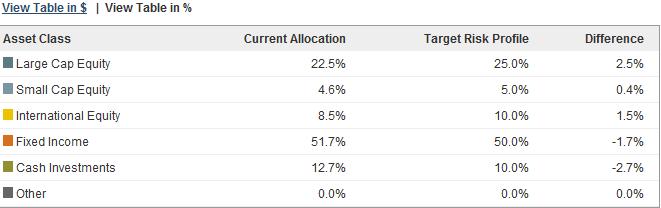
Click to Enlarge Now look at the right-hand column. This column shows the difference, by asset class, between actual portfolio sector holdings and the targeted percentage. Whenever it gets 5% off target, DIY Investor rebalances.
Assume, for the sake of argument, that the international sector had performed poorly and was 5% under target. Typically, DIY Investor would handle this by buying shares of SCHF, Schwab's international ETF, for a zero commission and an expense ratio of .13%.
DIY Investor wants to emphasize how important it is to grasp the ease with which this is all done. Check this allocation once a month, and you'll be fine. Whenever the market makes a big move, check to be sure exactly where you stand.
As an added guidepost check performance:
Notice that the account is ahead for the year and is doing a bit better than its benchmark. Understand that most investors cannot tell you what their asset allocation is and what their performance is on a year-to-date basis. In other words, they are flying blind. Understanding the technology available today (free by the way) goes a long way towards alleviating this shortcoming. Furthermore, I will say again that all of this takes very little time once you get the hang of it.
Disclosure: The information presented here is for educational purposes only. No specific securities are recommended. Investors should do their own research and consult with a professional before making investments. I am not affiliated with Charles Schwab and receive no compensation from them.
There are obviously different ways to do this. There is no absolute right way. What is important is that you do it, not so much how you do it. This is in the "there is more than one way to skin a cat" bucket. It is worth pointing out , however, that, by actually rebalancing on a regular basis, you will have an understanding of how your portfolio is positioned. DIY Investor appreciates that this is elementary to many readers, but he comes across plenty of investors who rebalance on an ad hoc basis. DIY Investor believes strongly that not knowing exactly how you are positioned and how performance is unfolding is a primary cause of the harmful emotional responses that occur in volatile markets.
Again, a systematic rebalancing plan presupposes that you have specific detail on portfolio positioning.
5% Rebalancing Rule
Investors use different ways and rules on how to rebalance, DIY Investor uses the 5% rule. If a portfolio class is more than 5% out of balance, then the portfolio has to be rebalanced. This is easy in today's world with the commission-free ETFs many brokers offer. Let's get down to specifics by using Schwab's tools. As always, DIY Investor urges all do-it-yourself investors to putter around on their broker's site to thoroughly understand the portfolio tools at their disposal. For our purpose, we'll use Schwab, the discount broker used by most of my clients.
Schwab offers 6 model portfolios, ranging from the most conservative with 0% stocks to the most aggressive with 95% stocks. Let's consider the popular "Moderate" portfolio which has 60% stocks and 40% fixed. This portfolio is used many times by investors moving into retirement.
![]() |
| Source: Schwab |
Again, consider a specific example:
![]() |
| Source: Schwab |
Click to Enlarge Now look at the right-hand column. This column shows the difference, by asset class, between actual portfolio sector holdings and the targeted percentage. Whenever it gets 5% off target, DIY Investor rebalances.
Assume, for the sake of argument, that the international sector had performed poorly and was 5% under target. Typically, DIY Investor would handle this by buying shares of SCHF, Schwab's international ETF, for a zero commission and an expense ratio of .13%.
DIY Investor wants to emphasize how important it is to grasp the ease with which this is all done. Check this allocation once a month, and you'll be fine. Whenever the market makes a big move, check to be sure exactly where you stand.
As an added guidepost check performance:
| Source: Schwab |
Disclosure: The information presented here is for educational purposes only. No specific securities are recommended. Investors should do their own research and consult with a professional before making investments. I am not affiliated with Charles Schwab and receive no compensation from them.
Tuesday, March 1, 2011
How to Index
Yesterday, DIY Investor argued that one of the keys to figuring out how to invest is to look at how the experts invest. DIY Investor looked at and presented some evidence on the extent to which some of the nation's largest pension funds index the assets they manage. He noted that, although they are well positioned to find superior performers with their well paid, highly educated advisors and staffs, they invest the bulk of their assets by indexing. In other words, they seek to achieve close to the return on the market. They aren't out there trying to find the market beaters with the bulk of their assets. This sends a powerful message in favor of the indexing approach - to DIY Investor as well as to many others.
So, how can the average investor index? How hard is it? Do you need to hire an advisor? DIY Investor is a bit battle weary because he has been battling on other sites those who claim indexing is complicated. Here, DIY Investor will show that it is fairly easy and support his thesis that many people, although admittedly not all, can do their own index investing.
Many people confuse investing with financial planning. Let's be clear, from the start, on the difference between the two. Financial planning is complicated. Financial planning is a road map to guide you over a number of years on your financial journey. Figuring out the amount to save to reach a target, along with assumptions about life expectancy, inflation, and market returns, is complicated. Understanding the tax implications of various transactions, how to finance a college education, how to title inherited IRAs, and so forth is all very complicated. Getting started on the road to estate planning, as a good financial planner will do for you, is complicated. All of this is financial planning. Depending on where you are in life, it may very well pay for you to get a financial plan done. And, financial plans are fairly expensive - on average a good plan costs about $2,700.
One of the outcomes of a well done financial plan is an asset allocation. This is where the investing part starts. To be clear, you don't need a financial plan to get an asset allocation; but a good financial plan will produce an asset allocation. To get an asset allocation by itself is not overly difficult and will be discussed in a future post.
For our purposes here, DIY Investor will assume that we have in hand an asset allocation. Again, note that this is the point where we separate with the financial planning firm. At the end of the presentation, they make the pitch to manage the money by arguing that it is complicated and that they only charge 1% of the market value of the assets. DIY Investor politely declines. If they start whipping out charts and talking about how they are great stock pickers and/or market timers, DIY Investor puts his hand on his wallet and runs for the door.
Now we are on the street, breathless, with asset allocation in hand:
It looks something like this. This is basically an 80% Equity/20% Fixed Income allocation. The percentages represent the target percentage for each asset class. Thus, 20%, for example, is targeted to the international equity class. This allocation wraps up a lot of what the planner found out about you. It takes into account your retirement goals, the number of years until you retire, how you are expected to respond to the ups and downs of the market, and both your need and capacity to take risk. It is one of those areas in which you should feel free to ask a lot of questions.
Investing
The next step is to get actual investments to implement the allocation. To begin, visit the iShares site . Next put your cursor on the "iShares ETFs" tab, and from the drop down list, click "Core Solutions." Scroll down and find:
CLICK TO ENLARGE For the "Newbies," the capital letters are ticker symbols. IVV is a "Large Cap Equity" offering, and it fits the bill for the first asset class. Note also that the expense ratio is only .09%. The average actively managed fund charges approximately 1.4%!
So go to Yahoo! Finance and put in the ticker symbol IVV, and find the price of $133.62/share. Assume your portfolio is $1.0 million. The asset allocation specifies 45% in large cap equity, i.e. $450,000. Divide $450,000 by the price of $133.62/share, and you find that you need to buy approximately 3,300 shares of IVV.
If at this point you know how to find prices of ETFs, have a discount brokerage account, know how to execute a trade, and followed the simple arithmetic above, you are good to go. If, in fact, you have a million dollar account, you've probably saved yourself at least $10,000/year in investment management fees.
An unabashed plug: for those who find this approach worth pursuing and yet don't feel quite up to getting it off the ground, I offer, at a reasonable fee (.4% of assets), to get it going by managing it for several months. This gets the initial set-up done, makes sure investments are located properly, and goes through the rebalancing process. Once they feel comfortable, they can take over the controls on their own. For those with a bit more experience, I offer hourly consulting to talk them through the process on the phone or sit down with them as they execute their trades.
An additional point: some brokers sell commission-free ETFs. These are very convenient for rebalancing - a subject DIY Investor will discuss in the future.
DISCLOSURE: DIY Investor may own some of the ETFS mentioned here. This information is for educational purposes only. Individuals should do their own research and consult an advisor before investing.
So, how can the average investor index? How hard is it? Do you need to hire an advisor? DIY Investor is a bit battle weary because he has been battling on other sites those who claim indexing is complicated. Here, DIY Investor will show that it is fairly easy and support his thesis that many people, although admittedly not all, can do their own index investing.
Many people confuse investing with financial planning. Let's be clear, from the start, on the difference between the two. Financial planning is complicated. Financial planning is a road map to guide you over a number of years on your financial journey. Figuring out the amount to save to reach a target, along with assumptions about life expectancy, inflation, and market returns, is complicated. Understanding the tax implications of various transactions, how to finance a college education, how to title inherited IRAs, and so forth is all very complicated. Getting started on the road to estate planning, as a good financial planner will do for you, is complicated. All of this is financial planning. Depending on where you are in life, it may very well pay for you to get a financial plan done. And, financial plans are fairly expensive - on average a good plan costs about $2,700.
One of the outcomes of a well done financial plan is an asset allocation. This is where the investing part starts. To be clear, you don't need a financial plan to get an asset allocation; but a good financial plan will produce an asset allocation. To get an asset allocation by itself is not overly difficult and will be discussed in a future post.
For our purposes here, DIY Investor will assume that we have in hand an asset allocation. Again, note that this is the point where we separate with the financial planning firm. At the end of the presentation, they make the pitch to manage the money by arguing that it is complicated and that they only charge 1% of the market value of the assets. DIY Investor politely declines. If they start whipping out charts and talking about how they are great stock pickers and/or market timers, DIY Investor puts his hand on his wallet and runs for the door.
Now we are on the street, breathless, with asset allocation in hand:
![]() |
| Adapted From Schwab |
Investing
The next step is to get actual investments to implement the allocation. To begin, visit the iShares site . Next put your cursor on the "iShares ETFs" tab, and from the drop down list, click "Core Solutions." Scroll down and find:
CLICK TO ENLARGE For the "Newbies," the capital letters are ticker symbols. IVV is a "Large Cap Equity" offering, and it fits the bill for the first asset class. Note also that the expense ratio is only .09%. The average actively managed fund charges approximately 1.4%!
So go to Yahoo! Finance and put in the ticker symbol IVV, and find the price of $133.62/share. Assume your portfolio is $1.0 million. The asset allocation specifies 45% in large cap equity, i.e. $450,000. Divide $450,000 by the price of $133.62/share, and you find that you need to buy approximately 3,300 shares of IVV.
If at this point you know how to find prices of ETFs, have a discount brokerage account, know how to execute a trade, and followed the simple arithmetic above, you are good to go. If, in fact, you have a million dollar account, you've probably saved yourself at least $10,000/year in investment management fees.
An unabashed plug: for those who find this approach worth pursuing and yet don't feel quite up to getting it off the ground, I offer, at a reasonable fee (.4% of assets), to get it going by managing it for several months. This gets the initial set-up done, makes sure investments are located properly, and goes through the rebalancing process. Once they feel comfortable, they can take over the controls on their own. For those with a bit more experience, I offer hourly consulting to talk them through the process on the phone or sit down with them as they execute their trades.
An additional point: some brokers sell commission-free ETFs. These are very convenient for rebalancing - a subject DIY Investor will discuss in the future.
DISCLOSURE: DIY Investor may own some of the ETFS mentioned here. This information is for educational purposes only. Individuals should do their own research and consult an advisor before investing.
Labels:
DIY investing,
indexed investing
Subscribe to:
Posts (Atom)