I apologize to all those people over the past three years to whom I talked and tried to the best of my ability to get into the stock market. I wish I was more persuasive. We sat together at the table (or Skyped) and looked at the huge amount you had in Certificates of Deposit at .75% or in money markets at 0.1% and I pleaded for you to open an account at Schwab (or the discount broker of your choice) and choose a low fee S&P 500 Index Fund for 60% of the assets.
I argued that the U.S. economy is the most innovative in the world, that products will be forthcoming that neither of us could foresee that would be in demand. We couldn't foresee Fitbits, or driverless trucks, or drones delivering packages. We couldn't foresee virtual reality. But all of it came and is coming big time.
You worried over government shutdowns, a slowing economy, the European Union breaking up and more recently Brexit and Trump. In your thinking you kept going back to the downturn in 2008 despite the fact that you had many years to recover if the market experienced a meltdown in the short run. To no avail I tried to emphasize that such a meltdown is a gift to the long term investor who is accumulating a nest egg for retirement.
The saving grace for me are the many who did invest for the first time and who gained the confidence and knowledge that put them on the path they need to be on. They held to a well defined asset allocation and have seen their assets appreciate significantly to return well above the rate of inflation. They learned to manage their own assets and avoid the egregious fees charged by the industry.
They are excellent examples of how straight forward it is to become do-it-yourself investors and participate fully in the free market capitalistic system.
Showing posts with label do-it-yourself investors. Show all posts
Showing posts with label do-it-yourself investors. Show all posts
Wednesday, December 21, 2016


Wednesday, March 2, 2011
How to Rebalance a Portfolio
On Monday, DIY Investor explained why individuals should use index funds and yesterday how to index. Now the question is how to stay on track? All of this presupposes an asset allocation plan, which DIY Investor will talk about in a future post. So, how does DIY Investor stay on track?
There are obviously different ways to do this. There is no absolute right way. What is important is that you do it, not so much how you do it. This is in the "there is more than one way to skin a cat" bucket. It is worth pointing out , however, that, by actually rebalancing on a regular basis, you will have an understanding of how your portfolio is positioned. DIY Investor appreciates that this is elementary to many readers, but he comes across plenty of investors who rebalance on an ad hoc basis. DIY Investor believes strongly that not knowing exactly how you are positioned and how performance is unfolding is a primary cause of the harmful emotional responses that occur in volatile markets.
Again, a systematic rebalancing plan presupposes that you have specific detail on portfolio positioning.
5% Rebalancing Rule
Investors use different ways and rules on how to rebalance, DIY Investor uses the 5% rule. If a portfolio class is more than 5% out of balance, then the portfolio has to be rebalanced. This is easy in today's world with the commission-free ETFs many brokers offer. Let's get down to specifics by using Schwab's tools. As always, DIY Investor urges all do-it-yourself investors to putter around on their broker's site to thoroughly understand the portfolio tools at their disposal. For our purpose, we'll use Schwab, the discount broker used by most of my clients.
Schwab offers 6 model portfolios, ranging from the most conservative with 0% stocks to the most aggressive with 95% stocks. Let's consider the popular "Moderate" portfolio which has 60% stocks and 40% fixed. This portfolio is used many times by investors moving into retirement.
CLICK TO ENLARGE After yesterday's post, the do-it-yourself investor knows how to go about selecting low-cost indexed ETFs that would be positioned in line with this specific portfolios asset allocation. For example, he or she knows where to go to find an appropriate ETF for the "International Equity" sector, how to price, and how to determine how many shares to buy. The question now is how to adjust over time as market movements change the percentage allocation relative to target allocations.
Again, consider a specific example:
Click to Enlarge Now look at the right-hand column. This column shows the difference, by asset class, between actual portfolio sector holdings and the targeted percentage. Whenever it gets 5% off target, DIY Investor rebalances.
Assume, for the sake of argument, that the international sector had performed poorly and was 5% under target. Typically, DIY Investor would handle this by buying shares of SCHF, Schwab's international ETF, for a zero commission and an expense ratio of .13%.
DIY Investor wants to emphasize how important it is to grasp the ease with which this is all done. Check this allocation once a month, and you'll be fine. Whenever the market makes a big move, check to be sure exactly where you stand.
As an added guidepost check performance:
Notice that the account is ahead for the year and is doing a bit better than its benchmark. Understand that most investors cannot tell you what their asset allocation is and what their performance is on a year-to-date basis. In other words, they are flying blind. Understanding the technology available today (free by the way) goes a long way towards alleviating this shortcoming. Furthermore, I will say again that all of this takes very little time once you get the hang of it.
Disclosure: The information presented here is for educational purposes only. No specific securities are recommended. Investors should do their own research and consult with a professional before making investments. I am not affiliated with Charles Schwab and receive no compensation from them.
There are obviously different ways to do this. There is no absolute right way. What is important is that you do it, not so much how you do it. This is in the "there is more than one way to skin a cat" bucket. It is worth pointing out , however, that, by actually rebalancing on a regular basis, you will have an understanding of how your portfolio is positioned. DIY Investor appreciates that this is elementary to many readers, but he comes across plenty of investors who rebalance on an ad hoc basis. DIY Investor believes strongly that not knowing exactly how you are positioned and how performance is unfolding is a primary cause of the harmful emotional responses that occur in volatile markets.
Again, a systematic rebalancing plan presupposes that you have specific detail on portfolio positioning.
5% Rebalancing Rule
Investors use different ways and rules on how to rebalance, DIY Investor uses the 5% rule. If a portfolio class is more than 5% out of balance, then the portfolio has to be rebalanced. This is easy in today's world with the commission-free ETFs many brokers offer. Let's get down to specifics by using Schwab's tools. As always, DIY Investor urges all do-it-yourself investors to putter around on their broker's site to thoroughly understand the portfolio tools at their disposal. For our purpose, we'll use Schwab, the discount broker used by most of my clients.
Schwab offers 6 model portfolios, ranging from the most conservative with 0% stocks to the most aggressive with 95% stocks. Let's consider the popular "Moderate" portfolio which has 60% stocks and 40% fixed. This portfolio is used many times by investors moving into retirement.
 |
| Source: Schwab |
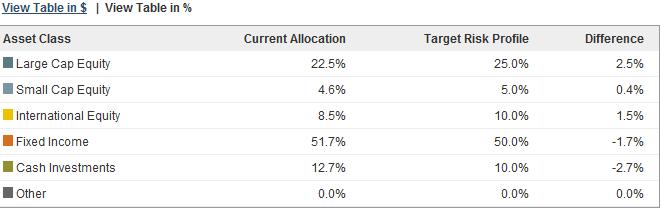
Again, consider a specific example:
 |
| Source: Schwab |
Click to Enlarge Now look at the right-hand column. This column shows the difference, by asset class, between actual portfolio sector holdings and the targeted percentage. Whenever it gets 5% off target, DIY Investor rebalances.
Assume, for the sake of argument, that the international sector had performed poorly and was 5% under target. Typically, DIY Investor would handle this by buying shares of SCHF, Schwab's international ETF, for a zero commission and an expense ratio of .13%.
DIY Investor wants to emphasize how important it is to grasp the ease with which this is all done. Check this allocation once a month, and you'll be fine. Whenever the market makes a big move, check to be sure exactly where you stand.
As an added guidepost check performance:
 |
| Source: Schwab |
Disclosure: The information presented here is for educational purposes only. No specific securities are recommended. Investors should do their own research and consult with a professional before making investments. I am not affiliated with Charles Schwab and receive no compensation from them.
Friday, November 5, 2010
Kiplinger's "Best Simple Portfolio"

Kiplinger's "The Best List" has a number of interesting entries this month, among which is their "Best Simple Portfolio"." In line with the theme of this site, it is comprised of low cost funds:
33% VTSMX Vanguard Total Stock Market
33% VGTSX Vanguard Total International Stock Index
33% VBMFX Vanguard Total Bond Market
This portfolio, as they point out, beats most investors. In fact, over some longer periods, similar types of portfolios, after fees, have been shown to beat 90% of active professional investors who tout their stock-picking and market-timing abilities.
Kiplinger's reports that, over the past 10 years, it has achieved an annualized return of 3%. Year-to-date through 11/4, it is up 11.14%.
I agree with Kiplinger but would prefer to use exchange traded funds and flesh out the portfolio a bit with a few extra funds. Also, the portfolio has to be adjusted for risk tolerance specific to particular investors. In any even,t investors can easily adapt the "simple portfolio" to use as a benchmark to assess how well they or their advisor is performing.
Tuesday, August 3, 2010
Coping With Emotions in a Volatile Market

Yesterday's post elicited a comment from Shawn in which he asked "...I do wonder how investors can deal with the emotions of the roller coaster ride we have been experiencing." This is the most important question facing do-it-yourself investors and the present environment is a great test. One day the market is falling off a cliff, all the news is negative, and doomsday commentary is everywhere. You feel like the character in Edvard Munch's painting. It makes a normal person want to cash it all in and sit on the sidelines.
The next day we get a piece of positive news: different commentators argue that the economy is in a recovery mode and that the worst possible scenario is a slowdown - not the dreaded double dip.
In the background, the news du jour is the sub-par long-term under performance of stocks. Over the last decade, investors were not rewarded for taking on risk which, of course, undercuts one of the main tenets, supposedly (actually investors can expect higher returns for incurring greater risk), of investment theory. Then there is the ongoing argument that a bond bubble is building.
All of this, as Shawn implies, is causing the arrow on the emotions meter to register in the danger zone. Again, how does the do-it-yourselfer cope?
Well (I'm taking a big breath here), we do know a couple of things. First, the average do-it-yourselfer is not going to do well in this environment. Simply, some who are completely out of stocks today will dive in aggressively if the S&P 500 rises 400 points. We know that there are diyers who capitulate every time the stock market drops by triple digits and then jump in when it's up a couple hundred points. DIYers like to buy high and sell low and tend to chase the best performing sector. Today that's bonds.
This behavior is the result of DIYers focusing on prices and not on the underlying businesses. Simply, if DIYers are not going to put in the time and resource-consuming effort they need to understand individual businesses, they need to index and capture market returns. Focusing on the erratic day-to-day price movements of individual stocks in a volatile market would even drive the Fonz to lose his cool.
Secondly, the last 10 years have been highly unusual. Ten years ago was near the end of the best 3 years in the history of the stock market! It was the most bullish environment ever experienced in the U.S. Valuations were skyrocketing, investors were convinced that old valuation metrics were irrelevant, and the bubble was wildly over inflated. We're not in a stock bubble today. In my view, it is a mistake to fixate on the last 10 years.
Thirdly, it is easy to emphasize what we can see; and it is impossible to see what is around the corner. Typically, on the business front, positives have been around the corner.
Some perspective: when I was the age of many of today's personal finance bloggers, I had to carry boxes of punch cards to the computer center at the university and get my results the next day. If I had a question about house prices over the past 20 years, I went the library; I didn't google "house prices." Businesses didn't have PCs on every desk. People had to actually answer their phones and, if you wanted to see a TV show, you had to be there when it aired.
Today's world is completely different. And it will be very different in 25 years. In terms of products produced by businesses (notice I'm steering clear of politics and the fiscal mess we are in!), it will likely be much better. We'll have completely different automobiles, medical technology will be much improved (and may actually lower medical costs), and, yes, today's computers will be like "pong" is to today's games.
Thus, for me, when I put all of this together, I go 100% with the advice offered by the school of thought that emphasizes low-cost indexed investing. Give a lot of thought to risk tolerance, how much you need to reach your retirement goals, and structure assets accordingly. Then live life - don't let the ups and downs of daily stock prices on the computer screen mesmerize you. To me this is how the DIYer copes.
Tuesday, April 6, 2010
AAII
One of the best resources around, in my opinion, for do-it-yourself investors is the American Association of Individual Investors. For a low annual fee you get access to all sorts of educational materials on investing, financial planning, and retirement issues. Included are such things as discussion boards and stock screens. Check out their website .
Perhaps the biggest benefit is joining the local chapter and meeting with investors to discuss topics of the day. Monthly meetings typically involve discussions and presentations by investment professionals. The Baltimore chapter, of which I am a member, usually meets on the first Saturday of each month. The Baltimore AAII website describes this Saturday's meeting.
Perhaps the biggest benefit is joining the local chapter and meeting with investors to discuss topics of the day. Monthly meetings typically involve discussions and presentations by investment professionals. The Baltimore chapter, of which I am a member, usually meets on the first Saturday of each month. The Baltimore AAII website describes this Saturday's meeting.
Subscribe to:
Posts (Atom)