Investment Help

If you are seeking investment help, look at the video here on my services. If you are seeking a different approach to managing your assets, you have landed at the right spot. I am a fee-only advisor registered in the State of Maryland, charge less than half the going rate for investment management, and seek to teach individuals how to manage their own assets using low-cost indexed exchange traded funds. Please call or email me if interested in further details. My website is at http://www.rwinvestmentstrategies.com. If you are new to investing, take a look at the "DIY Investor Newbie" posts here by typing "newbie" in the search box above to the left. These take you through the basics of what you need to know in getting started on doing your own investing.

Showing posts with label DIY newbie. Show all posts

Saturday, July 12, 2014

Peer-to-Peer Lending

I'm not a fan of Peer-to-Peer Lending or Investing, also known as "P2P."  Let me get that clear right up front.  To me, it may turn out to be one of those areas where the Fed pushing investors into ever riskier areas ends up being regretted.

Still, I do get queries about P2P from clients and others and so thought that this report "An Advisor's Guide to Peer-to-Peer Investing" by John Caldor would be of interest (pun intended!).  The article has a lot of really good info on the subject, including websites to visit.  The best investor is an educated investor.

Some points that interested me in my cursory overview:
  • idea of diversifying to the point that, even if historical default rates occur, the P2P investor still achieves a much higher yield than they would elsewhere at comparable risk.  This is an interesting point on a couple of fronts.  One is that this was the genesis, in fact, of the high yield or junk bond market.  Mike Milken found that this to be the case when doing research for a doctoral thesis.  In P2P lending, if you lend $1,000 by lending $25 to 40 different lenders at rates between 12 and 15%, say, you can still experience defaults at the highest historical rate and come out ahead.  A point of caution, though - historical default rates can be exceeded by a lot.  This was one of the key problems in the 2008 debacle with derivatives!
  • a second point on diversifying.  The article mentions 5 to 8% of total assets be confined to P2P.  I agree.  Remember that diversifying goes beyond number of issuers.  It also has to do with amount in sectors.  If you lend to 1,000 borrowers using 25% of your assets and the whole sector gets hit (think of banks in 2008), you're dead meat (see picture above)!  With flies circling!
  • a third point is the types of borrowers.  I winced when I saw the mention of debt consolidation and moving from 20% credit card balances to lower P2P lender rates.  Ooch!  The borrowers may have issues that lower rates won't solve.
Anyway, for those of you exploring this area, enjoy the article.  Keep in mind I am conservative in the investment arena. Your own research could very well determine P2P is an area you should participate in.

Friday, June 13, 2014

What is Your Investment Horizon?

 If you're like most people, thinking about time is not easy.  In the US, things are old if they are 2 or 3 hundred years old.  Go to Europe and tourists marvel at sites thousands of years old.  The 30-year-old finds it hard to imagine his or her 65th birthday.  It is a challenge thinking about retirement. "That's far off, I have plenty of time to get started later."  This, of course, gets investment people to wring their hands and gnash their teeth.

We realize that time is the investor's big ally.  Even a small difference in return over a long period can make a huge difference.  An 8% return on $10,000 compounded over 40 years gives you $217,245.  Increase the return by 1% and the ending value is $314,094.  Our mantra is "get invested early and correctly."  Warren Buffett is the shining example of this.  Fifty years ago, he was investing in well-run companies and holding on to them.

The time frame is referred to as investment horizon.  Understanding and thinking about your  investment horizon is an important piece to determining an appropriate asset allocation.  Other things being equal, the longer your investment horizon the greater the tolerance for volatility and, therefore, the greater the capacity to take on stocks.  In layman's terms, the longer your investment horizon the more time you have to recover from a market downturn.

Most people have a longer investment horizon than they think when it comes to retirement planning. For example, many people think right-off-the-bat that the investment horizon is the expected retirement date.  And it is, if you think you might drop dead on that date!  Otherwise, you probably want to continue to have your assets earning a decent return.  In fact, you may need them to continue earning a decent return for 30 or more years.

Another consideration is that you may have as a goal to leave an inheritance.  Now the horizon shifts from how long you are going to live to the life expectancy of your heirs.

The bottom line is that your investment horizon is probably longer than you think!  As a caveat, keep in mind the rule of thumb of investing very cautiously for monies you will need within 5 years.  For example, if you are saving for a down payment on a house, your horizon is probably less than 5 years. Keep these funds in very short-term bond funds or money market equivalents.

Wednesday, December 5, 2012

Can You Do This?

Source: Capital Pixel
What if I said to you, "You need to increase your large cap equity position by 2%."  Could you do it?

First, you would need a good handle on the market value of your assets.  Let's assume you have that at your fingertips - for example, you may be doing your annual rebalancing - and let's assume the total market value of your accounts is $800,000.  Then, by advanced calculus, you figure that 2% of $800,000 is $16,000.

Secondly, you would need to understand that it is coming from somewhere--some other asset class is over-weighted and will have to be reduced.  Or, maybe there are a couple of asset classes that have to be reduced.  To keep our problem simple, we'll assume that cash is over-weighted and that's, therefore, where the $16,000 will come from.

Step 3 is to figure out what to invest in to bolster the large cap position.  Depending on your investment approach, this could be stocks (for example, IBM and/or other large caps), it could be a mutual fund like the TIAA-CREF large cap index fund, or it could be an exchange traded fund that tracks the S&P 500 like SPY.  What it is depends on your overall investment philosophy and what's available to you.

Next, and finally, you need to get the price of what you need to buy and do some simple arithmetic.  For example, if you are buying a mutual fund and the price is $26.17, you divide $16,000 by $26.17 and find that you need to buy approximately 600 shares.  If, instead, you are making the adjustment in your 401(k), all you need do typically is go online and change your allocation - there is no need to do the actual trade.

If you're doing the trade, then you need to go to the broker site and enter the trade.

If you're sitting back and thinking that this is pretty easy, or even if you are thinking that you sort of get it, then I believe you can manage your own investments.  In the second case, it is usually a matter of sitting at the terminal and seeing a couple of trades done.  When all is said and done, this takes longer to explain and appears more complicated than it is.  And it is a big deal because over the years, if you can manage your own investments, it can make a meaningful contribution to your nest egg - to the tune of being able to retire a few years earlier!

Makes Sense to Sit Down With An Advisor

Having said all of this, I highly recommend that most people sit down with an advisor and go over the whole process.  There are some nuances.  You want to make sure the location of investments is appropriate.  For example, you pay taxes on interest and dividends in your taxable account.  Thus, holding bond funds in your 401(k) and IRAs makes more sense than in the taxable accounts.  You want to make sure you understand the expense ratios on any funds you own and ensure you are minimizing costs for what you are trying to do.  At the trading level, you want to observe the difference between the bid and ask spread and know how to see if a fund is trading at a premium or a discount.

In a major repositioning or rollover of an account, you want to understand if your funds have loads and whether gains are long term or not before you sell and reposition.

Depending on your familiarity with all of this, it pays, I have found, for most people to sit down with an advisor (on an hourly fee basis) and go over the investment philosophy and its execution.  More times than not, this process points out something that may have been overlooked.  Just make sure the advisor is just giving advice and is not selling products.

DIY Investment Management Sites

Here is a recent article, with the engaging title "You're Investing Like an Idiot," that looks at online investment management sites that enable individuals to manage their own money.  The article is a good place to start to see some different approaches that are out there.  Each site is different and will fit different investors.  MarketRiders, for example, enables you to select a broker (preferably a discount broker) and tells you what low cost funds to buy.

Betterment actually invests for you.  One difficulty I have is that, according to the article, Betterment invests the bond portion solely in U.S. Treasuries.  At least for me, this is a non-starter because Treasuries are so low-yielding.  Over time, this sacrifices considerable return.

The final site, Personal Capital, sounds intriguing.  According to the article, it has a free service that brings together all of your accounts - something that many investors ask about.  Managing assets holistically is important.


Monday, November 5, 2012

A Simple Asset Allocation Spreadsheet

At the bottom of this investment article from Rutgers University, directed to farmers, is a simple Excel spreadsheet one of my clients found for tracking asset allocation.  The spreadsheet is useful for bringing accounts together and determining when re-balancing needs to take place.  As has been discussed here frequently, asset allocation is the most important determinant of overall investment return.

The approach I, and many others, recommend is to identify an appropriate asset allocation and stick to it through market ups and downs.  In this way, the key emotional factors that investors struggle with are defeated.

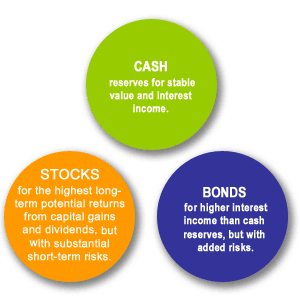
Cash investments include money market accounts, certificates of deposit, savings accounts, etc.  Fixed income investments include bonds, bond mutual funds, and bond ETFs, etc.

Once you get the hang of it, you should break out equities into domestic and foreign.  Somewhere down the line, you may want to also break out large cap and small cap stocks.

Saturday, July 7, 2012

Client Makes First Trade

Source: Capital Pixel
Experts continually point out that market timing and stock picking over long periods of time underperform the major market indices after taking into account fees, hidden and explicit, charged by active managers.

The impact on retirement assets can be substantive.  This has, understandably, attracted considerable attention to indexed investing.

The icing on the cake that investors are coming to understand is that the process is easy, doesn't require a lot of time, and can readily be monitored to see if you are on track to produce the required nest egg in retirement.

This week I introduced the trading part of the process to a novice investor.

We first reviewed 3 basic steps:  asset allocation, figuring out how to invest, and monitoring the process.  We chose an asset allocation model that is basically 40% stocks/60% fixed income/cash.  She is 42 years old and this is her entry into the world of investing, so she is starting a bit conservatively.  She set up her brokerage account with Schwab.

The model is: 
Source: Schwab

CLICK GRAPHIC TO ENLARGE  As you can see, the targeted percentage for each asset class is specified.  From here she just needs to know what funds to invest in, do a little arithmetic, and where to go on the Schwab site .

Broker sites will have a prominent link on their main page to execute a  trade.  Click on the Schwab trade link and it takes you to:
Source: Schwab

CLICK TO ENLARGE This, of course, is where you enter the trade.

She opened her account with $10,000 and, by her model (above), she wants 25% in "Large Cap Equity."  Thus, she needs to invest approximately $2500 in a "Large Cap Equity" index ETF.

There are several ways to find the ticker symbol for various choices.  One way is to Google "large cap indexed ETFs."  Another way is to find someone who is knowledgeable about markets.  I suggested the commission-free Schwab ETF with ticker symbol SCHX.

At the bottom of each Schwab page is a quote box, which she used to find the price of SCHX.

Source: Schwab
She divided $2500 (amount she wanted to invested as determined above) by the price-per-share of $32.21, and she found that she needed to buy approximately 75 shares.

From here it is straightforward.  In the box above, she entered the symbol (SCHX), selected "buy" from the "Action" drop-down menu, entered 75 in the "Quantity" box, and chose "Market Order" from the "Order Type" drop-down list.  Then she clicked "Review Order."


CLICK TO ENLARGE  Note the estimated dollar amount of the trade.  On the same page, the amount available to trade is also given.  It is good practice to get in the habit of eyeballing this amount.

All she had to do next was to scroll down and hit the green "PLACE ORDER" button.

She had made her first trade!

Disclosure:  This post is for educational purposes.  Individuals should do their own research or consult a professional before investing.


Wednesday, August 24, 2011

Paul Merriman Videos on Portfolio Construction

Biz of Life presents 9 videos as the first part of a series that details the process of portfolio construction by renowned investment manager Paul Merriman.  The explanations are very well done.  Merriman shows how, over the longer term, based on academic evidence, adding asset classes increases expected compound annual return from 9.5% to 12%.  He clearly demonstrates the role of risk in the portfolio construction process.

This is one of the best explanations I have seen on this complex subject and is the starting point for understanding the investment process.  I highly recommend these videos for newbies as well as a review for more knowledgeable investors.  Those who make a living explaining these concepts will surely appreciate Merriman's clear presentations.

Tuesday, May 10, 2011

A Great Graduation Gift!

Bemoaning the lack of financial literacy among the young is a popular pastime.  The problem involves the need for programs in the high schools, the lack of interest among students, and  the ever-evolving complexity of the financial services industry.  The result is that young people enter the work force and inevitably make numerous mistakes ranging from losing control of their credit cards to not saving enough early enough.

I Will Teach You To Be RichHere is a step in the right direction.  When you show up at the college graduation barbecue party, put a copy of  I Will Teach You to be Rich by Ramit Sethi on the gift table.  This book speaks to young people and covers all the areas that a young person starting their first "real" job, getting ready to set up a household, and initiating a retirement savings program needs to know.  When they are getting their first "real" paycheck, all of a sudden the subjects in this book become highly relevant.  Timing, as in so many areas of life, is important.

The book is set up as a 6-week program and lists actionable items for the reader.

I recommend it highly.

Friday, April 23, 2010

DIY Investor Newbie - Risk Tolerance (Cont.)


As you view the video, notice the questions that have to do with emotions. Emotions are the enemy of the investor. Emotions cause investors to get carried away as prices rise and to capitulate at bargain basement prices. If you are too emotional, you are better off letting a professional handle your money.